Jesus Invites Your Backchat

Okay then, Lord: What the hell?
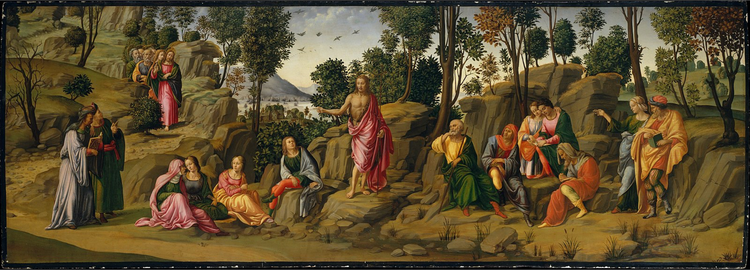
When Jesus is on, he’s on. His Sermon on the Mount is worth the price of admission right there.
But sometimes he’s just bass-ackward and late for breakfast. I mean, how would you score his performance here, on the coast of modern day Lebanon?
The Faith of a Canaanite Woman
21 Leaving that place, Jesus withdrew to the region of Tyre and Sidon. 22 A Canaanite woman from that vicinity came to him, crying out, “Lord, Son of David, have mercy on me! My daughter is demon-possessed and suffering terribly.”
23 Jesus did not answer a word. So his disciples came to him and urged him, “Send her away, for she keeps crying out after us.”
24 He answered, “I was sent only to the lost sheep of Israel.”
25 The woman came and knelt before him. “Lord, help me!” she said.
26 He replied, “It is not right to take the children’s bread and toss it to the dogs.”
27 “Yes it is, Lord,” she said. “Even the dogs eat the crumbs that fall from their master’s table.”
28 Then Jesus said to her, “Woman, you have great faith! Your request is granted.” And her daughter was healed at that moment. — Matthew 15:21–28
Today we usually interpret being “demon possessed,” as suffering from mental illness.
Let’s remember that the peak/median age at onset of 14.5/18 years across all mental disorders. This woman’s daughter was probably — like many teens and young adults today — gut-punched by her first encounter with schizophrenia, bipolar disorder, or some other psychoactive bully.
So why would Jesus, of all people, turn her away?
I mean, I wouldn’t. At least I don’t think so. If the person Vladimir Putin or Benito Mussolini asked me to help their ailing child, I’d throw in. It’s not like they’re asking for help with invading a country or something.
But…there does seem to be a bit of a blue state versus red state thing going on here.
Pardon my Greek
The woman was described in Mark 7:26 as a Συροφοινίκισσα (Syrophoenician), and Χαναναία (Canaanite) in Matthew 15:22.
Canaanites were — yep — natives of Canaan; their ancestors were living in Palestine before the Exodus…before Moses had ever heard of “the land of milk and honey.”
A Syrophoenician was an inhabitant of Phoenicia when it was part of the Roman province of Syria. Most (but not all) sources agree that they were of a similar ethnic group to the Israelites.
The main difference wasn’t ethnicity but culture.
Rich, hip, cosmopolitan, and Gentile
Syrophoenician society was a thalassocracy — meaning it’s people inhabited the port cities. They worked the trade routes that extended from Palestine across Mediterranean Sea and out into the Atlantic.
This woman’s Phoenician ancestors settled a host of colonies in Southern Europe and North Africa, including Carthage in modern day Tunisia, and Gades (Cadiz) in Spain.
Flyover states
By comparison, Jesus and most of his followers were cow-town kids from fly-over states. They were tradespeople, freshwater fishermen, and farmers.
We only have to look at our society today to understand the gaping cultural gap between these groups of people.
Because they were closely related — but divided by (what we would say were) minor differences — Jews and Syrophoenician “othered” each other like no one’s business.
Yes, I said, “because,” not “despite.”
Recall for a second all the things we assume we know about a stranger, based solely on their accent. See? You know what’s going on here between Jesus and this woman.
This isn’t how the Roman Centurion was treated.
When a different Gentile, with a similar problem, approached Jesus, his reception was completely different:
5 When Jesus had entered Capernaum, a centurion came to him, asking for help. 6 “Lord,” he said, “my servant lies at home paralyzed, suffering terribly.”
7 Jesus said to him, “Shall I come and heal him?” — Matthew 8:5–7
Wow, Jesus nearly broke my neck with that whipsnap response. “You’ve got a problem? I’m your man!” So, why did this Gentile receive different treatment?
- Was it because Rome occupied Judaea?
True, Jesus doesn’t come down on Romans very hard in the canonical Gospels. After Christianity became the state religion of Rome, theologians and scribes had centuries to soften Jesus’s words when he was speaking of Romans, and to harden them when speaking of his fellow Jews.
- Was it because he was a man (in patriarchal times)?
Nope: Jesus famously had women in his closest circles.
Jesus was subversive to patriarchy. He showed great respect to women and included them in his mission and ministry. Often he praised their faith as greater than his male disciples. Jesus engaged women in theological discussions and protected them from abusive practices. — Harriet Reed Congdon: The Junia Project
After his death some of the most powerful Christian teachers were women, such as Martha, Susanna, Mary Magdalene, Priscilla, Lydia, Phoebe, Dorcas, Thecla, and Prisca. Jesus’s ministry opened up a brief window of time in which women enjoyed not only equality but a chance at leadership roles in the new faith.
So, was Jesus simply having a cranky moment with the Syrophoenician woman — or was something else at work here?
Women-with-backbone vs. the entire Greco-Roman world
Sources on how Canaanite women were viewed by their society are thin on the ground.
We can, however, learn much about Roman sensibilities toward women. Their writings about other cultures are most instructive.
Notice the Roman historian Tacitus’ shock in learning that German “barbarians” valued their women.
They do not scorn to ask their advice, or lightly disregard their replies. In the reign of the emperor Vespasian we saw Veleda long honoured by many Germans as a divinity; and even earlier they showed a similar reverence for Aurinia and a number of others — a reverence untainted by servile flattery or any presence of turning women into goddesses. — Tacitus, Germania. (Emphasis mine.)
If we are to believe Tacitus, the only females Romans honored were deities — divine beings who would step on your head if you didn’t pony up the respect.
Even more telling — here are his thoughts on women in roles of authority:
The tribes of the Sitones adjoin those of the Suiones. Similar in other respects, they differ in this, that the women rule: in this respect they are not only inferior to freemen but even to slaves. — Tacitus, Germania (Emphasis mine, again.)
In the Jewish culture of Jesus’ time, women were neither to be seen nor heard as they were considered “corrupting influences to be shunned and disdained” — Gilbert Bilezikian, Beyond Sex Roles
Totally counter-culture: Jesus’ ministry was largely to — and through — women
Yet, Jesus was sub-enthusiastic with this particular woman, until she bounced his arguments back at him.
She remained respectful — as far as we can tell from this distance anyway — but.
She refused to grovel or turn away.
She hung on like a pit bull until she got what she came for — her daughter’s health being restored to her.
Who knows? Before she was pushed to the breaking point, perhaps this woman hadn’t been able to — or found the need to — bust out of the role society kept her in.
To put in in modern terms, maybe this is when she found her inner strength. She found her truth, her voice. Like in Han Kang’s novel The Vegetarian, mental illness drives profound internal change in everyone who loves the sufferer.
Perhaps Jesus saw this in the woman’s face. Perhaps he said the one thing that would shatter the woman’s old self, and show her the new person she already was inside.
“Less best practices, more Zen koan”
My old boss told me this when I came to him, close to tears, feeling like I’d just failed with a client.
This was when I was in grad school; I was interning on the night shift at a crisis hotline.
I wondered, would there be a woman hanging from her fire escape when the sun came up? Yes my patience had snapped after her 450th excuse for not making even the smallest move toward change. She was fighting hard in defense of her stickiness, her inability, her weakness. She was clinging hard to her depression, defending it at all costs. Complaining, but not seeking change.
She’d called in the first place because she wanted to kill herself, but seemed so damned cheeky about it, like she was a bratty teenager and I was the school attendance monitor.
I was exhausted. It was 3 a.m., and I had an 8 a.m class in a few hours.
I was pretty sure she was jerking me around.
Being jerked around is common for crisis hotline staff; some people call simply to hear a young woman’s voice so they can masturbate. The joke is to see how long they can keep you on the line before you figure it out.
So, at some point in a 90-minute call, I said this:
You don’t want a fix — You’re too in love with your suffering. I’d want to kill myself too if I were as unwilling to change as you.
Having been a solid wall of “no” for an hour and a half, the woman suddenly started sobbing uncontrollably into the phone and hung up.
Oh shit.
I know, I know. Now that I’m older I understand more about the dynamics of clinical depression. What the fuck did I know, then? I was a student intern, with a couple hours of training on how to handle overdoses.
And as I stood in my supervisor’s office, I was pretty sure I’d killed this poor woman.
My boss looked at me with a sad smile. I don’t recall his exact words, but they went something like this —
“You never know what crazy bullshit thing is going to help. The thing that seems the most wrong might be the exact thing that works. You don’t know how her particular brain-box is put together. Fuck the rules. This work is less best practices and more Zen koan.”
A Zen koan, you say?
The words that break open our outer shell, our world-facing exterior, the facade we think is real?
Did Jesus intuit this woman’s hidden need — one that went beyond what she thought was her up-front issue? Jesus could surely hand out tailor-made advice, as he did with the rich young ruler in Matthew 19.
Or, maybe, in this case, Jesus just had places to go. Maybe he was on a tight schedule. Even the Dalai Lama has to catch a plane sometimes.
Either way, Jesus turned around. He said to the woman: “For such a reply, you may go; the demon has left your daughter.”
Good game, good game!
Damn, I wish we knew this woman’s name. I’d make a plaque in her honor, St. Canaanite Woman, and underneath it I’d write:
Don’t be afraid to chase after God
Yeah, you! You’ve got questions?
Demand some answers. Challenge what’s been handed down.
It’s righteous to say, “no fair!”
You’re punching up, remember? Stop trembling and turning away.
True divinity put that spark in your heart, that grit in your gut, that logical mind that says, “wait, WTF?”
It’s in your hardware — not a bug, but a feature.
If this woman had shrunk away
and said, “oh well, it’s God’s will”, then her daughter would have suffered for a lifetime.
But she didn’t.
And we shouldn’t either.
First appeared in Medium.